Lost in the Soul of Naples: Where Culture Lives on Every Corner
Ever wondered what it feels like to step into a living museum? Naples isn’t just a city—it’s a raw, pulsing embrace of history, art, and daily ritual. From street-side puppet shows to ancient bakeries crafting the world’s first pizza, I discovered how deeply culture thrives in plain sight. This is not about ticking landmarks off a list—it’s about feeling the heartbeat of a place that refuses to be tamed by time. The moment you arrive, Naples wraps around you with an energy that’s chaotic, yes, but never cold. It’s the kind of city where tradition doesn’t live behind glass cases but spills out onto sidewalks, into kitchens, and through open windows filled with song. To walk its streets is to witness culture not as performance, but as life itself—unfiltered, unapologetic, and alive.
Arrival: First Impressions of a City That Defies Expectations
The first breath of Naples hits like a story already in progress. As you step off the train at Napoli Centrale, the air carries a mix of diesel, simmering tomatoes, and freshly ground espresso. The city doesn’t greet you with quiet elegance; it announces itself with urgency—vendors calling out, mopeds weaving through pedestrian traffic, and voices rising in passionate conversation from open balconies. The narrow streets of the historic center seem to lean into one another, clotheslines strung between buildings like threads holding the neighborhood together. Sunlight filters through, catching on dangling socks and children’s drawings taped to windowpanes.
Many arrive with caution, warned of Naples’ reputation for disorder or petty crime. Yet what quickly becomes apparent is not danger, but a profound sense of presence. People are not rushing past—they are living in full view. An old woman leans from her window to scold a neighbor in singsong Italian. A young man repairs a scooter on the sidewalk, surrounded by tools and curious onlookers. There’s a rhythm here, one not dictated by clocks but by habit, history, and heart. This is a city that resists tidiness, and in doing so, preserves something more valuable: authenticity.
The warmth is immediate. When I asked for directions to a small bakery mentioned in a guidebook, the shopkeeper didn’t just point—he walked me there, stopping to greet three other locals along the way. Each exchange was a small performance of belonging: a kiss on the cheek, a shared joke, a hand on the shoulder. These gestures aren’t for show; they are the fabric of daily life. Naples teaches you quickly that culture isn’t found only in monuments. It begins with how people treat each other on the street—how they argue, laugh, and share space.
And then there’s the sound. From the first morning, music drifts through the alleys—someone practicing the mandolin, a radio tuned to a Neapolitan folk station, children chanting a skipping rhyme passed down for generations. It’s impossible to feel like a stranger for long when the city itself is singing. This sensory richness isn’t accidental. It’s the result of centuries of layered history—Greek roots, Spanish rule, French influence—all blending into a cultural stew that refuses to be simplified. Naples doesn’t perform for tourists. It simply is. And in that honesty lies its deepest invitation.
The Art of Daily Life: Culture Beyond Museums
While Naples boasts world-class museums like the National Archaeological Museum and the Certosa di San Martino, the true soul of its culture unfolds far from curated galleries. It lives in the morning ritual of buying bread from a wood-fired bakery, in the way a fishmonger at the Mercato di Porta Nolana throws his hands up while arguing price, or how a grandmother blesses herself at a small roadside shrine before crossing the street. These moments aren’t preserved for posterity—they are part of the daily pulse.
One of the most revealing experiences is joining the passeggiata, the evening stroll that transforms the city’s streets into social stages. As the sun lowers behind Mount Vesuvius, families emerge—children in polished shoes, couples arm-in-arm, elders moving slowly but proudly. They don’t walk with a destination in mind. They walk to see and be seen, to exchange news, to pause at a café for a small glass of lemon liqueur. In neighborhoods like Quartieri Spagnoli or Vomero, the sidewalks buzz with conversation, laughter, and the occasional burst of song. This is where tradition breathes—not in silence, but in sound and movement.
What makes these rituals powerful is their unselfconsciousness. No one is performing for cameras or tourists. A man sings a verse of 'O Sole Mio while hanging laundry. A group of teenagers dances to a smartphone speaker on a street corner. These acts are not isolated moments of whimsy; they are expressions of a culture that values emotion, connection, and expression above restraint. In a world where many cities sanitize their identities for global appeal, Naples remains defiantly itself.
Even the city’s chaos reveals order. The tangled streets of the historic center, often criticized as disorganized, follow an ancient logic of community. Shops are not grouped by type but by family lineage—three generations of shoemakers on one block, a succession of pastry chefs on the next. The market isn’t laid out in neat grids; it’s a living organism, shifting with the seasons, the saints’ feast days, and the catch of the day. To walk through it is to witness a culture that values relationship over efficiency, memory over modernity.
Pizza as Heritage: A Bite of Living History
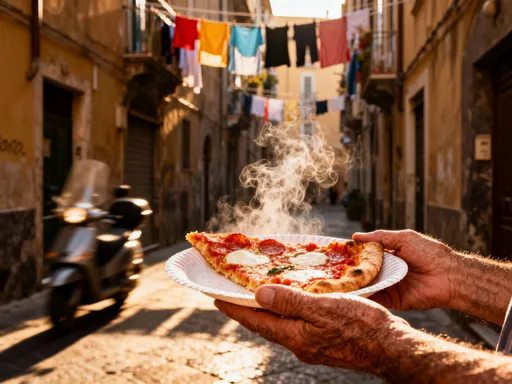
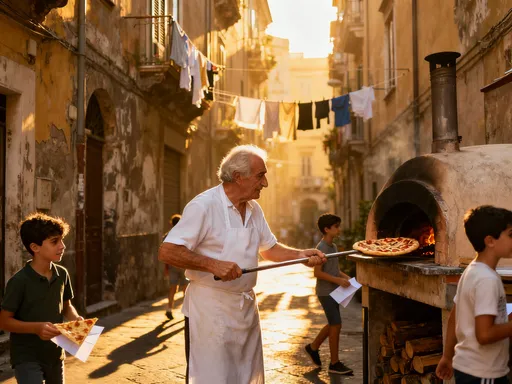
No experience in Naples is more iconic—or more deeply cultural—than eating pizza in the city where it was born. Not just any pizza, but the true Neapolitan Margherita: simple, sacred, and protected by law. The Associazione Verace Pizza Napoletana sets strict standards—only specific flour, San Marzano tomatoes, fresh mozzarella di bufala, and a wood-fired oven reaching 900 degrees Fahrenheit. But more than ingredients, it’s the method that matters. This is not fast food. It’s a ritual.
Visiting a traditional pizzeria in the heart of Spaccanapoli, I watched a pizzaiolo stretch dough by hand, his fingers moving with the ease of decades. There was no timer, no scale—just instinct. The pizza spent barely 90 seconds in the oven, emerging with a charred, leopard-spotted crust and a center so soft it trembled. Eating it the local way—folded in half, standing at the counter—was an act of participation. This wasn’t dining; it was communion.
In 2017, UNESCO recognized the art of Neapolitan pizza-making as an Intangible Cultural Heritage of Humanity. This wasn’t just about food. It was an acknowledgment of a tradition passed from hand to hand, generation to generation. The pizzaiolo isn’t a chef in the modern sense; he’s a guardian of craft. His hands carry the knowledge of centuries, and his oven is a hearth around which community forms.
The Margherita itself tells a story—its red, white, and green mirroring the Italian flag, created in honor of Queen Margherita in 1889. But beyond symbolism, it represents a philosophy: that greatness lies in simplicity, that pride comes from doing one thing perfectly. In Naples, pizza isn’t a meal. It’s identity. And when you eat it here, you’re not just tasting history—you’re becoming part of it.
Hidden Courtyards and Forgotten Theaters: Off-the-Beaten-Path Encounters
Beyond the crowded streets and famous landmarks, Naples hides quieter, more intimate stages of culture. Tucked behind unmarked doors in crumbling palazzi are the clausure—hidden courtyards that once belonged to noble families but now serve as sanctuaries for artists, dancers, and musicians. These spaces are rarely advertised. You find them by invitation, by chance, or by following the sound of a violin drifting through an alley.
I stumbled upon one such courtyard in the Rione Sanità district, where a local theater group was rehearsing a scene from opera buffa, the comic opera tradition that flourished in 18th-century Naples. The performance was raw, unamplified, and utterly captivating. The actors played not for an audience, but for each other and the walls that had heard centuries of music. There was no ticket booth, no program—just the joy of keeping something alive.
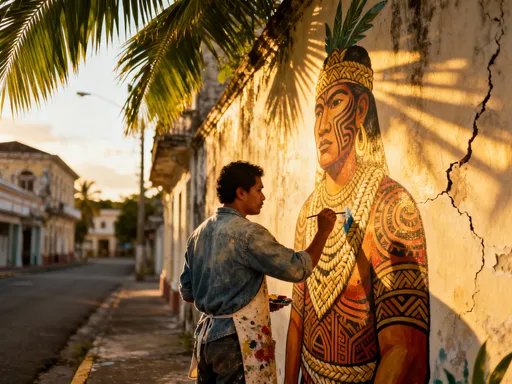
These spaces are vital. In a city where tourism can flatten culture into souvenirs, the clausure remain resistant to commodification. They are places where tradition evolves without being diluted. A young choreographer might blend tarantella steps with contemporary dance. A muralist paints over peeling frescoes, not to erase history but to converse with it.
Another discovery was the enduring presence of puppet theater, particularly the Sicilian tradition of Opera dei Pupi, which has deep roots in southern Italy. In a small basement theater near Piazza Bellini, I watched a puppet master manipulate iron-armored figures in a dramatic reenactment of medieval battles. The voices were provided live, the sound effects handmade. Children in the front row gasped and laughed, not because it was quaint, but because it was thrilling. This is culture that doesn’t ask to be preserved in amber—it demands to be felt, now.
Festivals That Move the Streets: When the City Becomes a Stage
In Naples, religion and culture are inseparable. Nowhere is this more evident than during the Feast of San Gennaro, the city’s patron saint, celebrated three times a year with processions, prayers, and the much-anticipated miracle of the liquefaction of his blood. On these days, the city transforms. Streets are carpeted with flowers, balconies draped in white and red, and the cathedral fills with thousands holding their breath.
I witnessed the September celebration, when the vial of dried blood is held before the altar. The tension is palpable. Locals cross themselves, whispering prayers. When the liquid finally stirs—sometimes within minutes, sometimes after hours—the crowd erupts in cheers, applause, and spontaneous singing. Whether one believes in the miracle or not, the emotion is real. It’s not just about faith; it’s about identity. San Gennaro is seen as protector, as family. His well-being is tied to the city’s fate.
But the festival extends far beyond the cathedral. The procession that follows winds through the streets, with the silver reliquary carried on the shoulders of devoted men. Music fills the air—brass bands, folk singers, children chanting hymns. Shops close. Families gather on rooftops. Even those who rarely attend church join in the ritual, not out of obligation, but out of belonging.
These festivals are not tourist spectacles. They are acts of collective memory. They remind Neapolitans who they are and where they come from. And for visitors lucky enough to witness them, they offer a rare glimpse into a culture that measures time not by calendars, but by saints, seasons, and shared stories. In a world where many traditions fade, Naples chooses to carry them forward—not quietly, but with noise, color, and heart.
Conversations with Keepers of Tradition
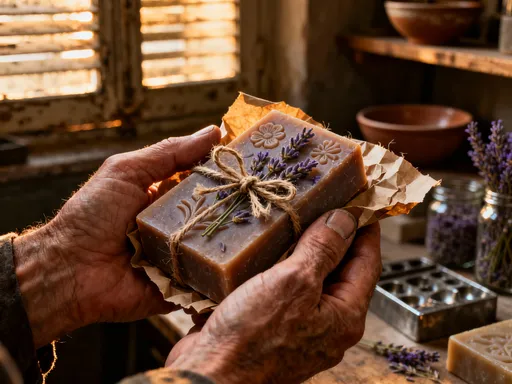
The true custodians of Neapolitan culture aren’t always the loudest. They’re the quiet artisans whose hands shape the city’s soul. In a small workshop near Via dei Tribunali, I met a luthier crafting a mandolin by hand, the same way his grandfather did. The wood was aged, the varnish applied in thin layers over weeks. “People think Naples is loud,” he said, sanding a delicate curve. “But listen closely. The music starts here, in silence.”
Another morning, I visited a studio where women handcraft figures for the famous presepe, the elaborate Nativity scenes that fill homes and churches each December. Each face was painted with individual expression—wise shepherds, sleeping infants, angels with feathered wings. One artisan told me her family had been making these for 150 years. “We don’t just make Christmas,” she said. “We make memory.”
On a Sunday afternoon in a community center in the historic center, I watched an elderly couple teach children the steps of the tarantella. The dance, once believed to cure spider bites, is now a joyful expression of resilience. The children laughed, stumbled, tried again. The woman leading the class had taught for forty years. “They don’t need to be perfect,” she said. “They just need to feel it.”
These encounters revealed a quiet determination. Tradition in Naples isn’t maintained by institutions alone—it’s carried by individuals who choose, every day, to pass it on. They don’t do it for fame or profit. They do it because to stop would be to lose a part of themselves. Their pride isn’t boastful; it’s humble, deep, and enduring. And in their hands, culture isn’t a relic. It’s a living thread.
Why Naples Changes How You See Culture
By the end of my stay, Naples had reshaped my understanding of what culture means. In so many cities, tradition is packaged—presented in museums, timed performances, or souvenir shops. But Naples refuses to be contained. Here, culture is not observed. It is absorbed. It’s in the way a baker folds a pizza, the way a child sings a lullaby, the way an entire city holds its breath for a miracle.
What makes Naples extraordinary is not its monuments, though they are many. It’s the unbroken continuity between past and present. The woman selling sfogliatella on the corner uses a recipe from 1818. The fisherman mending his nets sings a tune older than his grandfather. The graffiti on the wall quotes a poet from the 1600s. History isn’t behind glass. It’s in the air.
This is not a city that performs authenticity. It lives it. And in doing so, it offers a rare gift to the traveler: the chance to step outside the curated, the convenient, and the predictable. To be in Naples is to be reminded that culture is not a product. It is a practice. It requires participation, patience, and presence.
For the 30- to 55-year-old woman who travels not for escape but for connection, Naples speaks directly to the heart. It invites her to slow down, to listen, to engage. It doesn’t dazzle with perfection. It moves with humanity. And in its chaos, its noise, its unapologetic life, it offers something increasingly rare: truth.
So let this be a call—not to visit Naples, but to experience it. Not to photograph it, but to feel it. Let the music enter your bones. Let the flavors linger on your tongue. Let the streets teach you their rhythm. Because in the soul of Naples, we don’t just discover a city. We remember what it means to be alive.